Instagram Post via API: Publish Posts, Reels & Carousels (2026)
Instagram's Graph API works, but it's the strictest of Meta's posting APIs. Personal accounts can't connect at all. You need a Business or Creator account.
App Review takes weeks and demands a recorded walkthrough of your app using each permission. Publishing isn't a single POST either. You create a container, poll until it's ready, then publish.
PostPeer gives you a single endpoint that handles all of that. OAuth is done for you. The container-and-publish dance is done for you. App Review is done for you. Here's how to set it up.
What you need
- A PostPeer account (free tier works)
- Your access key from the dashboard
- An Instagram Business or Creator account (personal accounts cannot post via API, this is Meta's limit, not ours)
Step 1: Get your API key
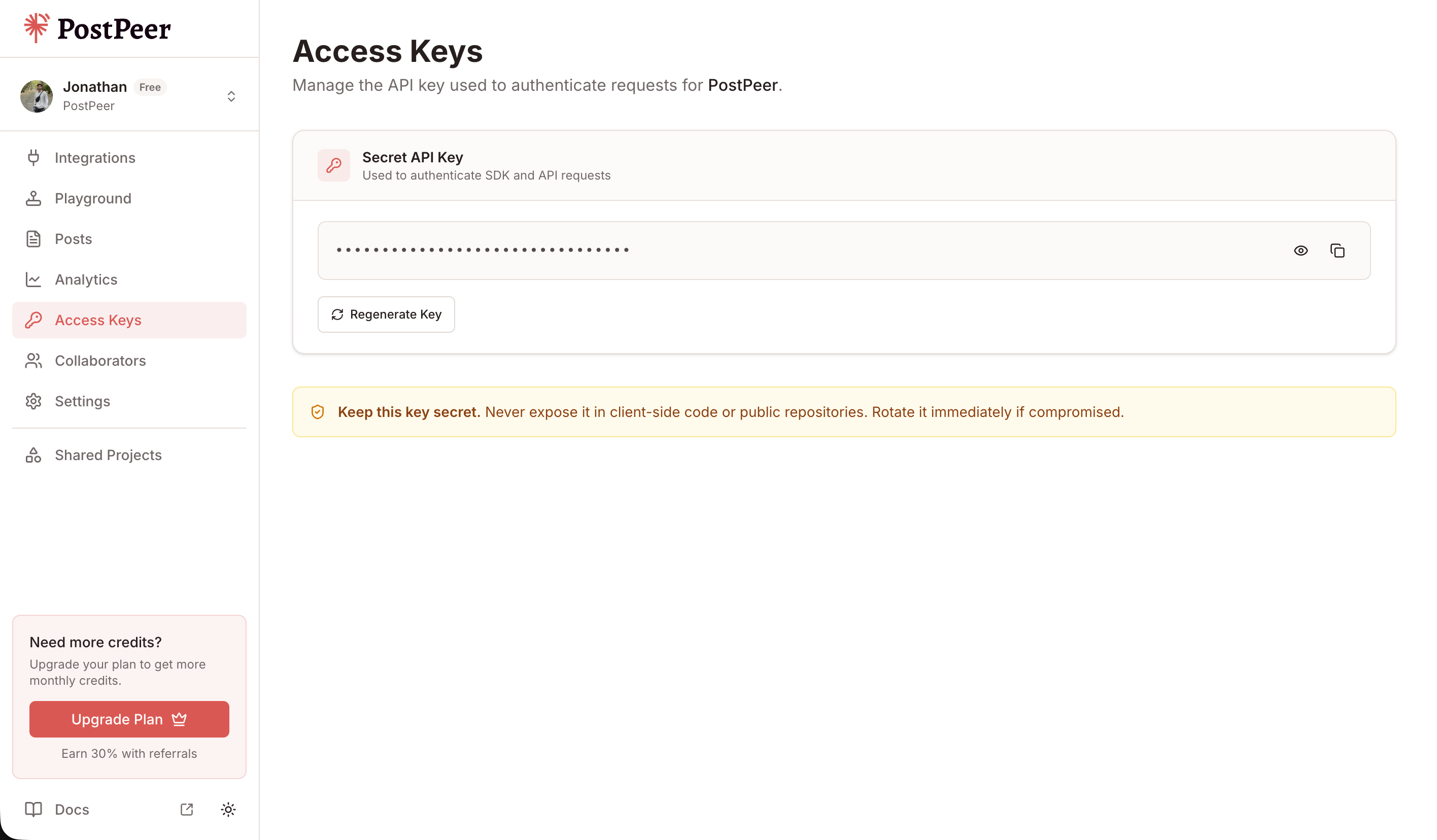
Sign up at PostPeer, head to the dashboard, and grab your access key from the Access Keys page. Every request uses the x-access-key header:
-H "x-access-key: YOUR_API_KEY"Grab your API key from the Access Keys page in your dashboard. Treat it like a password.
Step 2: Connect your Instagram account
PostPeer handles the OAuth flow. Hit the connect endpoint to get an authorization URL:
curl https://api.postpeer.dev/v1/connect/instagram \
  -H "x-access-key: YOUR_API_KEY"
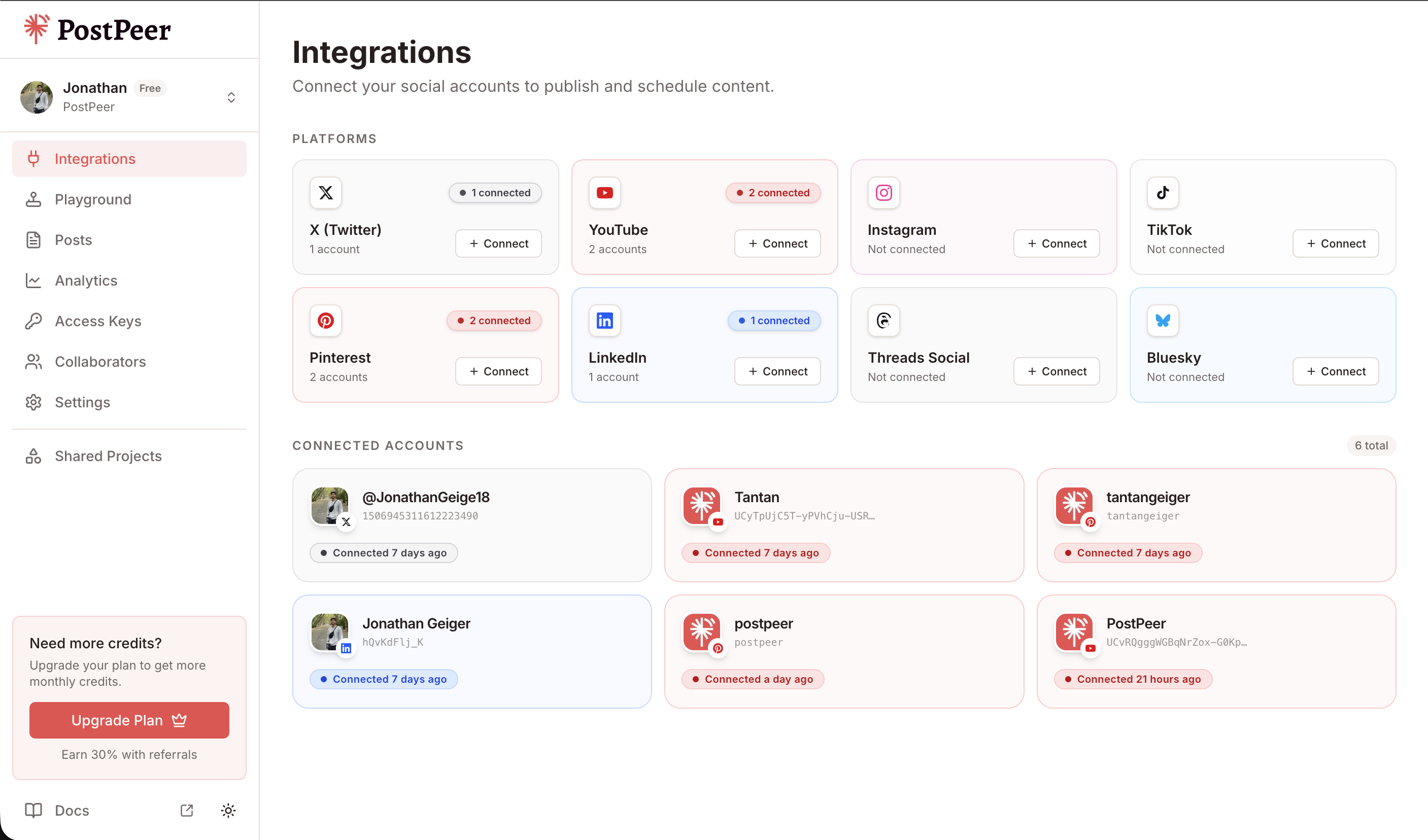
You'll get back a URL. Open it in a browser, authorize the app, and your Instagram Business account is linked. Grab the account ID from the integrations endpoint:
curl https://api.postpeer.dev/v1/connect/integrations \
  -H "x-access-key: YOUR_API_KEY"
The response includes an id for each connected account. That's your accountId for posting. You can also do this from the PostPeer dashboard if you'd rather click a button.
Step 3: Post a single image (feed post)
Instagram doesn't allow text-only posts. Every feed post needs one image or one video. Captions are capped at 2,200 characters. Single-image feed post:
curl -X POST https://api.postpeer.dev/v1/posts \
  -H "x-access-key: YOUR_API_KEY" \
  -H "Content-Type: application/json" \
  -d '{
    "content": "Behind the scenes from this week. #BTS",
    "platforms": [
      { "platform": "instagram", "accountId": "your-ig-id" }
    ],
    "mediaItems": [
      { "type": "image", "url": "https://your-cdn.com/photo.jpg" }
    ],
    "publishNow": true
  }'
PostPeer creates the media container at /{ig-user-id}/media, polls until Instagram reports it's ready, then triggers /{ig-user-id}/media_publish. The response includes the published media ID and permalink.
Step 4: Post a Reel
Same shape, swap type: "image" for type: "video". Instagram automatically classifies vertical short-form video as a Reel:
curl -X POST https://api.postpeer.dev/v1/posts \
  -H "x-access-key: YOUR_API_KEY" \
  -H "Content-Type: application/json" \
  -d '{
    "content": "Quick tip: stop debugging by adding print statements. #devtips",
    "platforms": [
      { "platform": "instagram", "accountId": "your-ig-id" }
    ],
    "mediaItems": [
      { "type": "video", "url": "https://your-cdn.com/reel.mp4" }
    ],
    "publishNow": true
  }'
Reels need to be 9:16 aspect ratio, between 3 and 90 seconds, MP4 or MOV. PostPeer validates basic specs before kicking off the upload so you don't burn credits on rejected media.
Step 5: Post a carousel (2–10 items)
Pass multiple mediaItems. PostPeer creates a child container per item, waits for each to be ready, then creates a parent CAROUSEL container and publishes it — all in one API call. Mix of images and videos is allowed.
curl -X POST https://api.postpeer.dev/v1/posts \
  -H "x-access-key: YOUR_API_KEY" \
  -H "Content-Type: application/json" \
  -d '{
    "content": "Recap from yesterday's launch event.",
    "platforms": [
      { "platform": "instagram", "accountId": "your-ig-id" }
    ],
    "mediaItems": [
      { "type": "image", "url": "https://your-cdn.com/1.jpg" },
      { "type": "image", "url": "https://your-cdn.com/2.jpg" },
      { "type": "video", "url": "https://your-cdn.com/3.mp4" }
    ],
    "publishNow": true
  }'
Note: videos inside a carousel are treated as standard videos, not Reels. Reels can't be embedded in carousels per Instagram's spec, so the cover/thumbnail/share-to-feed flags for Reels don't apply here.
Step 6: Post an Instagram Story
Stories use the same endpoint. Set contentType to "story" and pass one image or video. Story publishing requires an Instagram Business account.
curl -X POST https://api.postpeer.dev/v1/posts \
  -H "x-access-key: YOUR_API_KEY" \
  -H "Content-Type: application/json" \
  -d '{
    "content": "",
    "platforms": [
      {
        "platform": "instagram",
        "accountId": "your-ig-id",
        "platformSpecificData": {
          "contentType": "story"
        }
      }
    ],
    "mediaItems": [
      {
        "type": "image",
        "url": "https://your-cdn.com/story.jpg"
      }
    ],
    "publishNow": true
  }'
Instagram doesn't display content as a Story caption, so leave it empty. The media URL needs to be publicly accessible. PostPeer handles the publishing flow, and the Story disappears after 24 hours.
Scheduling an Instagram post
Replace publishNow with scheduledFor and timezone. The post sits in a queue and goes out at the right moment:
curl -X POST https://api.postpeer.dev/v1/posts \
  -H "x-access-key: YOUR_API_KEY" \
  -H "Content-Type: application/json" \
  -d '{
    "content": "Weekly product update going live Monday morning.",
    "platforms": [
      { "platform": "instagram", "accountId": "your-ig-id" }
    ],
    "mediaItems": [
      { "type": "image", "url": "https://your-cdn.com/weekly.jpg" }
    ],
    "scheduledFor": "2026-06-15T09:00:00",
    "timezone": "America/New_York"
  }'
Scheduled and published posts show up in the Posts dashboard, where you can filter by status, platform, and date.
The free Instagram post scheduler is the same API behind a UI. Useful for testing the flow before wiring it into code.
Cross-post a vertical video to Reels, TikTok, and YouTube Shorts
The whole point of a multi-platform API. One vertical video, one request, three platforms:
curl -X POST https://api.postpeer.dev/v1/posts \
  -H "x-access-key: YOUR_API_KEY" \
  -H "Content-Type: application/json" \
  -d '{
    "content": "New tutorial out now!",
    "platforms": [
      { "platform": "instagram", "accountId": "your-ig-id" },
      {
        "platform": "tiktok",
        "accountId": "your-tt-id",
        "platformSpecificData": { "privacyLevel": "PUBLIC_TO_EVERYONE", "draft": false }
      },
      {
        "platform": "youtube_shorts",
        "accountId": "your-yt-id"
      }
    ],
    "mediaItems": [
      { "type": "video", "url": "https://your-cdn.com/vertical.mp4" }
    ],
    "publishNow": true
  }'
PostPeer adapts the upload flow per platform. Instagram does the container plus publish dance. TikTok uses Content Posting init/poll. Shorts uses YouTube's resumable upload. From your side, it's one request.
Pulling Instagram analytics
PostPeer also exposes an Instagram Analytics API on the same /v1/analytics endpoint. Likes and comments per media item:
curl "https://api.postpeer.dev/v1/analytics?source=platform&platform=instagram&accountId=your-ig-id&limit=20" \
  -H "x-access-key: YOUR_API_KEY"
Each call costs 1 credit regardless of how many media items come back.
What's next
That covers single images, Reels, carousels, Stories, scheduling, and cross-posting. If you're building anything that publishes to Instagram at scale, this is the fastest way there.
Full reference is on the Instagram posting API page. Edge cases and advanced options are in the API docs.
If you're just getting started, the free tier includes 20 posts so you can test the whole flow without paying. Or play with the free Instagram post scheduler for a no-code version.
Frequently Asked Questions
What are Instagram API media requirements?
When publishing to Instagram through PostPeer, the media requirements depend on the post type. Feed images can be JPG or PNG with an aspect ratio between 4:5 and 1.91:1. Carousels support up to 10 JPG, PNG, MP4, or MOV items and should use a consistent aspect ratio.
For Reels, PostPeer currently documents MOV or MP4 video, a duration of 3 seconds to 15 minutes, 23–60 FPS, and a maximum file size of 300 MB. A 9:16 aspect ratio is recommended. Your media must also be available through a public URL so PostPeer and Instagram can access it. The full format list per platform lives on the Instagram posting API page.
How does PostPeer handle the Instagram Content Publishing API?
PostPeer handles Instagram's asynchronous media publishing process behind its unified POST /v1/posts endpoint. You provide the connected Instagram account, content, media URL, and publishing options in the request, while PostPeer handles the platform-specific publishing workflow.
The same endpoint can be used for Instagram feed posts, Reels, Stories, and carousels, so you do not need to create separate publishing integrations for each format. See the create post docs for the full request shape.
What are common Instagram API posting errors and how do I solve them?
Instagram publishing can fail when the media URL is not publicly accessible or when the image or video does not meet Instagram's supported media requirements. Account requirements can also matter, since feed posts and Reels require a professional Business or Creator account, while Story publishing requires a Business account.
When a PostPeer request fails, check the platform-level error in the publishing response. You can also retrieve the post later to inspect its errorMessage. After fixing the issue, use PostPeer's retry endpoint to retry only the failed platform. Platforms that have already published successfully are not posted again.
How can I check my Instagram post status after publishing with PostPeer?
PostPeer returns a postId when you create a post. If Instagram finishes publishing within the initial request window, the response can return published along with the live platformPostUrl.
If Instagram is still processing the post, the response can return publishing. Use GET /v1/posts/{postId} or list your posts to check the latest result. PostPeer supports statuses including pending, scheduled, publishing, published, failed, and partial, and retrieved posts can include the Instagram post URL and error details.
What are the Instagram API rate limits?
Instagram applies native API limits to publishing and other API activity. When you publish through PostPeer, PostPeer respects those native platform limits and automatically queues posts to help avoid throttling.
PostPeer also has its own rate limits based on your plan. Because the effective limit can depend on both Instagram and your PostPeer plan, PostPeer does not document one universal Instagram requests-per-minute number for every account. See the pricing page for plan limits.