100+ Social Media Management Statistics for 2026
Whether you manage one brand account, run social for several clients, or want numbers behind your next marketing decision, you probably came here looking for a specific social media management statistic.
Social media management covers the work behind planning, publishing, monitoring, and measuring a brand's presence across social platforms. That can mean scheduling posts one week and comparing channel performance the next, with approvals, reporting, audience responses, and platform changes mixed in between.
I'm Jonathan Geiger, co-founder of PostPeer, a unified social media API for publishing, scheduling, analytics, comments, and messaging across major platforms.
Because I work closely with social publishing and APIs, I spend a lot of time looking at how teams manage social media and where that work is changing.
I put these statistics together in one place so you can quickly find the latest data on usage, workload, AI, spending, and performance in 2026. Each statistic includes the source name, and I've listed the direct source links at the end of this article so you can verify the data or use the original research for your own citations.
Let's get started.
Social Media Management Market Statistics
How Big Is the Social Media Management Market in 2026?
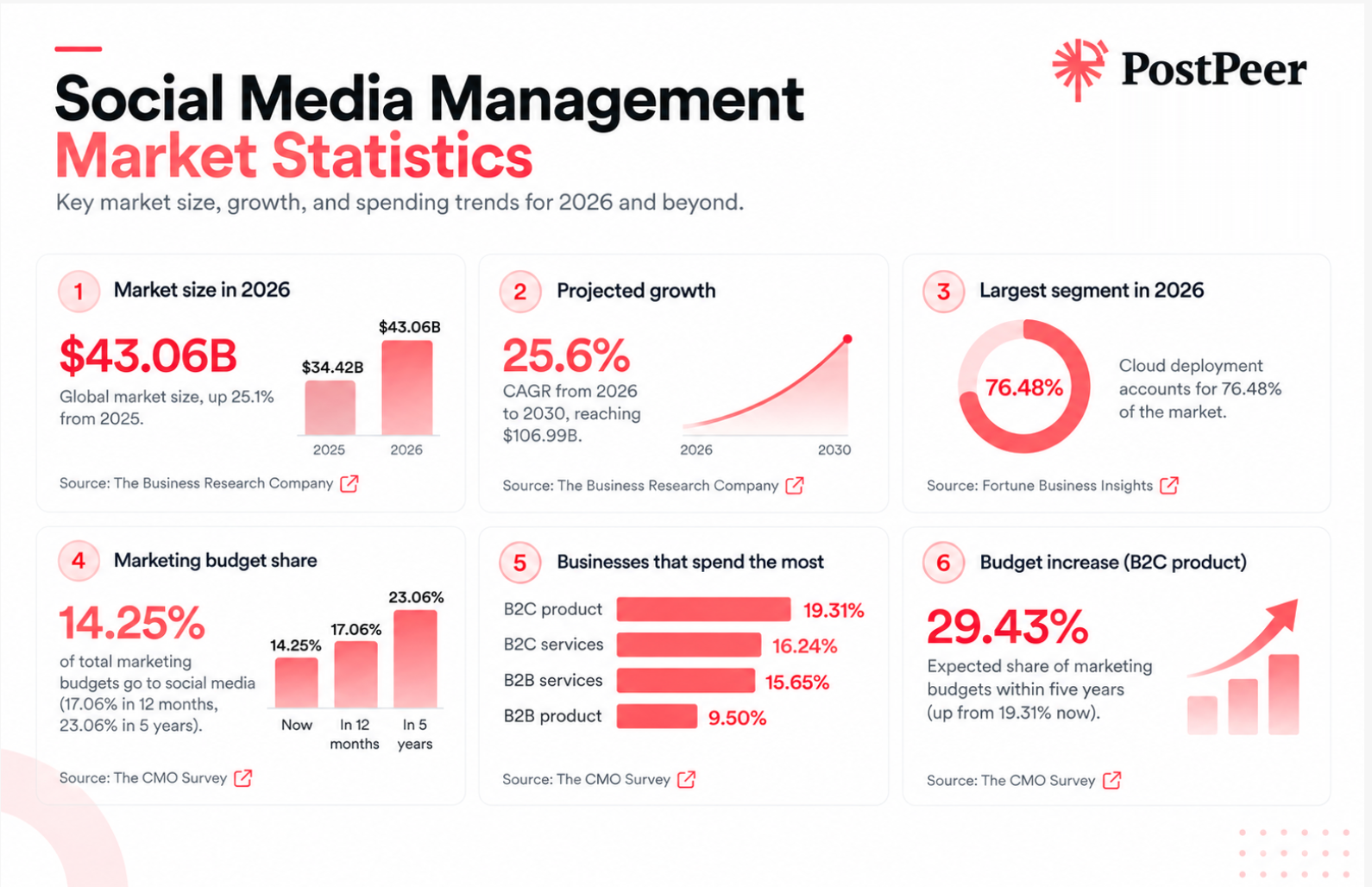
The global social media management market is expected to reach $43.06 billion in 2026, up from $34.42 billion in 2025. That represents 25.1% year-over-year growth.
The Business Research Company expects the market to reach $106.99 billion by 2030, with a 25.6% CAGR between 2026 and 2030.
Source: The Business Research Company, Social Media Management Market Report 2026
How Fast Is the Social Media Management Market Expected to Grow?
Current forecasts all point to strong double-digit growth, although the exact rate varies depending on the research methodology and forecast period.
Grand View Research expects the market to grow at a 24.8% CAGR from 2026 to 2033, while Fortune Business Insights forecasts a 19.70% CAGR from 2026 to 2034. The Business Research Company is more bullish, projecting 25.6% annual growth through 2030.
That puts current long-term forecasts at roughly 20% to 26% annual growth.
Sources: Grand View Research | Fortune Business Insights | The Business Research Company
How Is the Social Media Management Market Split in 2026?
Fortune Business Insights breaks the social media management market down by deployment, application, end user, and region. These percentages describe different cuts of the same market, so read them separately rather than adding them across categories.
- By deployment: Cloud accounts for 76.48% of the market in 2026, leaving 23.52% for on-premises deployment.
- By application: Sales and marketing management holds 37.41%, while customer experience management, risk and fraud detection, competitive intelligence, and other applications make up the remaining 62.59%.
- By end user: Media and entertainment represents 30.34% of the market, with all other industries accounting for the remaining 69.66%.
- By region in 2025: North America accounts for 39.30%, Asia Pacific 25.30%, Europe 24.10%, the Middle East & Africa 6.50%, and Latin America 4.80%. Together, these regional shares total 100%.
The complementary figures such as 23.52%, 62.59%, and 69.66% are calculated from Fortune Business Insights' reported leading-segment shares, so each individual split totals 100%.
Source: Fortune Business Insights, Social Media Management Market Size, Share & Industry Analysis
How Much of Marketing Budgets Goes to Social Media?
Companies currently spend an average of 14.25% of their total marketing budgets on social media, according to The CMO Survey.
Marketers expect that share to increase to 17.06% within the next 12 months and 23.06% within five years. The current and 12-month figures are based on 163 responses, while the five-year projection is based on 161.
If those expectations play out, social media's share of the average marketing budget would increase by nearly nine percentage points over five years.
Source: The CMO Survey, Topline Report 2026, page 42
Which Businesses Spend the Most on Social Media?
B2C product companies currently dedicate the largest share of their marketing budgets to social media.
In 2026, B2C product companies allocate an average of 19.31% of their marketing budgets to social media. B2C services follow at 16.24%, B2B services at 15.65%, and B2B product companies at 9.50%.
That means B2C product businesses currently dedicate roughly twice the share of their marketing budget to social media as B2B product companies.
Source: The CMO Survey, Firm and Industry Breakout Report 2026, page 133
How Much Could Social Media Budgets Increase Over the Next Five Years?
Both B2B and B2C businesses expect social media to take a larger share of their marketing budgets.
B2C product companies expect their social media allocation to increase from 19.31% today to 22.52% within 12 months and 29.43% within five years.
B2B service companies expect spending to rise from 15.65% to 19.22% within a year and 24.45% within five years. B2B product companies expect their share to increase from 9.50% today to 11.69% in 12 months and 17.44% within five years.
Source: The CMO Survey, Firm and Industry Breakout Report 2026, page 133
Multi-Platform Social Media Management Statistics
How Many Social Media Platforms Does the Average Person Use Each Month?
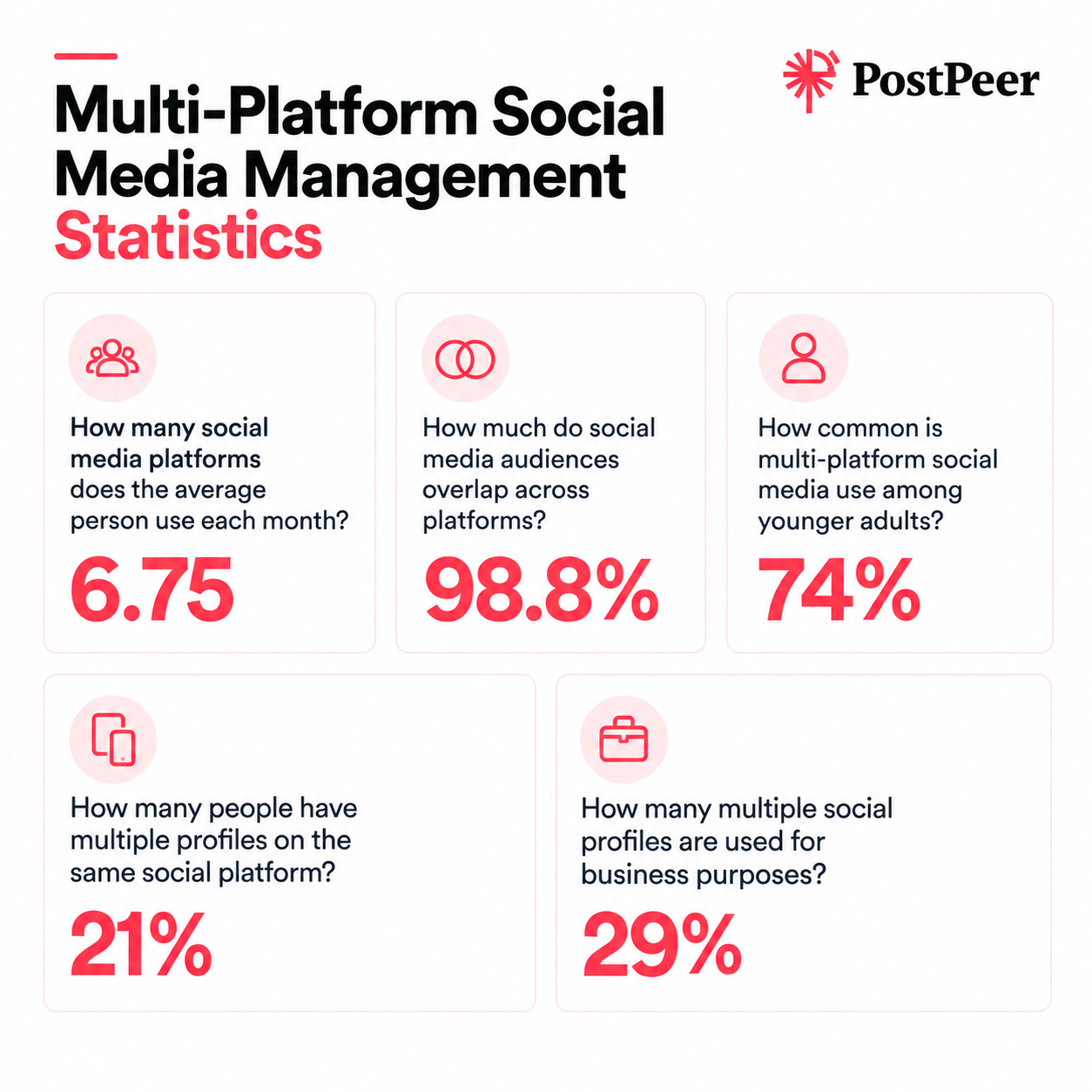
The typical online adult uses an average of 6.75 different social media platforms each month, according to GWI data published in DataReportal's Digital 2026 research.
Source: DataReportal, Digital 2026: 2 in 3 People on Earth Now Use Social Media
How Much Do Social Media Audiences Overlap Across Platforms?
DataReportal found that at least 98.8% of users of any major social platform also use at least one other social platform during the same month.
It also reports that 75.7% of YouTube's monthly adult users use Facebook, while 74% of active WhatsApp users also use YouTube.
Source: DataReportal / GWI, Digital 2026: 2 in 3 People on Earth Now Use Social Media
How Common Is Multi-Platform Social Media Use Among Younger Adults?
Pew Research Center found that 74% of U.S. adults under 30 use at least five of the social platforms included in its survey.
Source: Pew Research Center, Americans' Social Media Use
How Many People Have Multiple Profiles on the Same Social Platform?
Ofcom found that 21% of UK internet users had more than one profile on the same online communication platform in 2024.
Among those with multiple profiles, 45% had multiple Instagram profiles, 29% had multiple Facebook profiles, and 25% had multiple TikTok profiles.
Source: Ofcom, Adults' Media Use and Attitudes 2025
How Many Multiple Social Profiles Are Used for Business Purposes?
Among people with multiple profiles, 29% said they maintained a separate account for promoting a business or for business purposes.
That rises to 35% among 25- to 34-year-olds.
Source: Ofcom, Adults' Media Use and Attitudes 2025
Social Media Posting & Scheduling Statistics
Which Social Networks Are B2B Marketers Increasing Their Use Of?
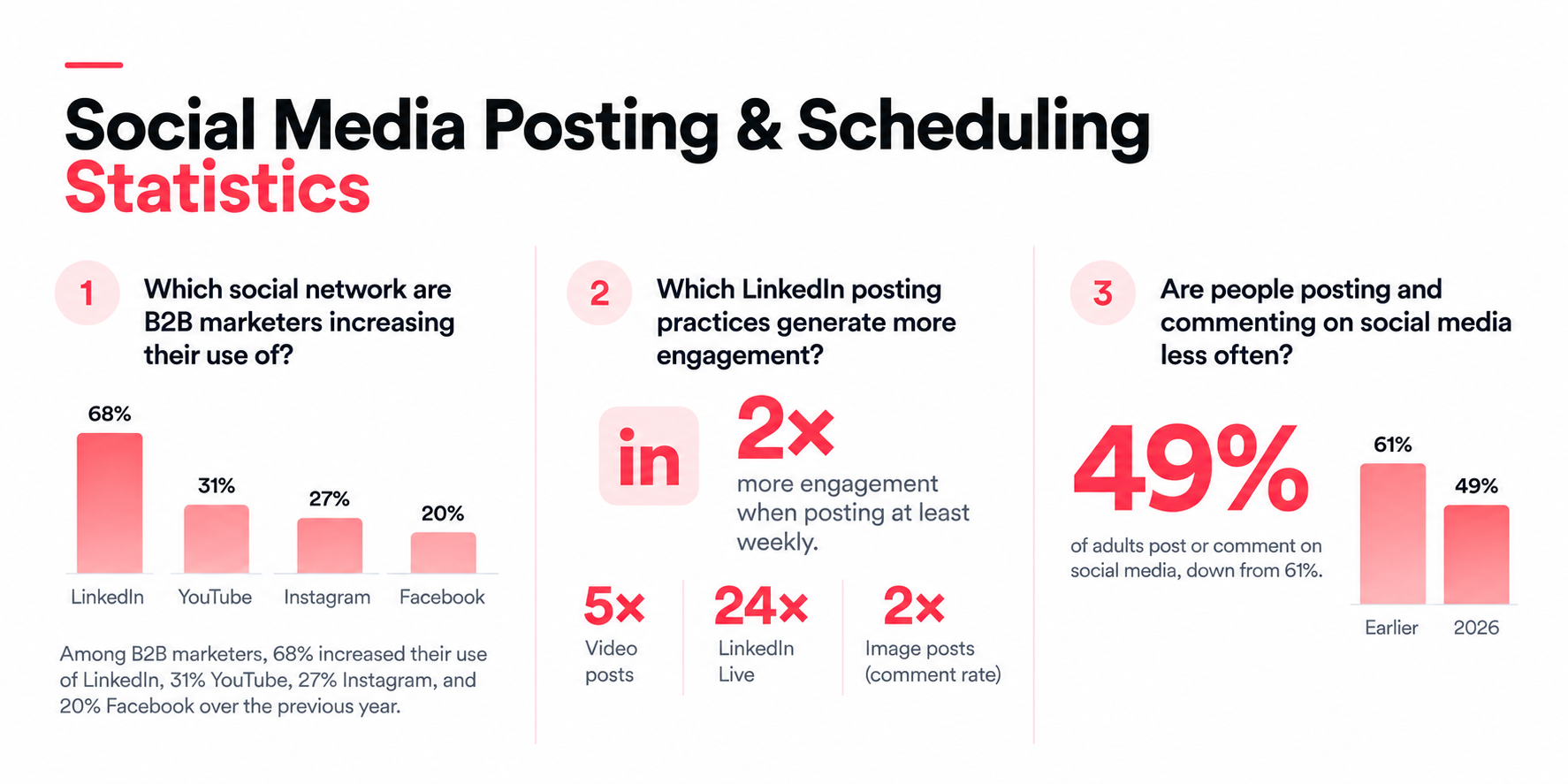
Among B2B marketers, 68% increased their use of LinkedIn, 31% increased YouTube, 27% increased Instagram, and 20% increased Facebook over the previous year.
TikTok increased by 9%, while Reddit and X each increased by 6%.
Source: Content Marketing Institute, B2B Content Marketing Benchmarks, Budgets, and Trends: Outlook for 2025
Which LinkedIn Posting Practices Generate More Engagement?
LinkedIn reports that companies posting at least weekly see a 2× lift in engagement compared with companies posting less frequently.
Format also matters. Video generates 5× more engagement, while LinkedIn Live generates 24× more engagement. Posts containing images typically receive a 2× higher comment rate.
Source: LinkedIn, LinkedIn Pages Best Practices
Social Media Engagement & Comment Statistics
Are People Posting and Commenting on Social Media Less Often?
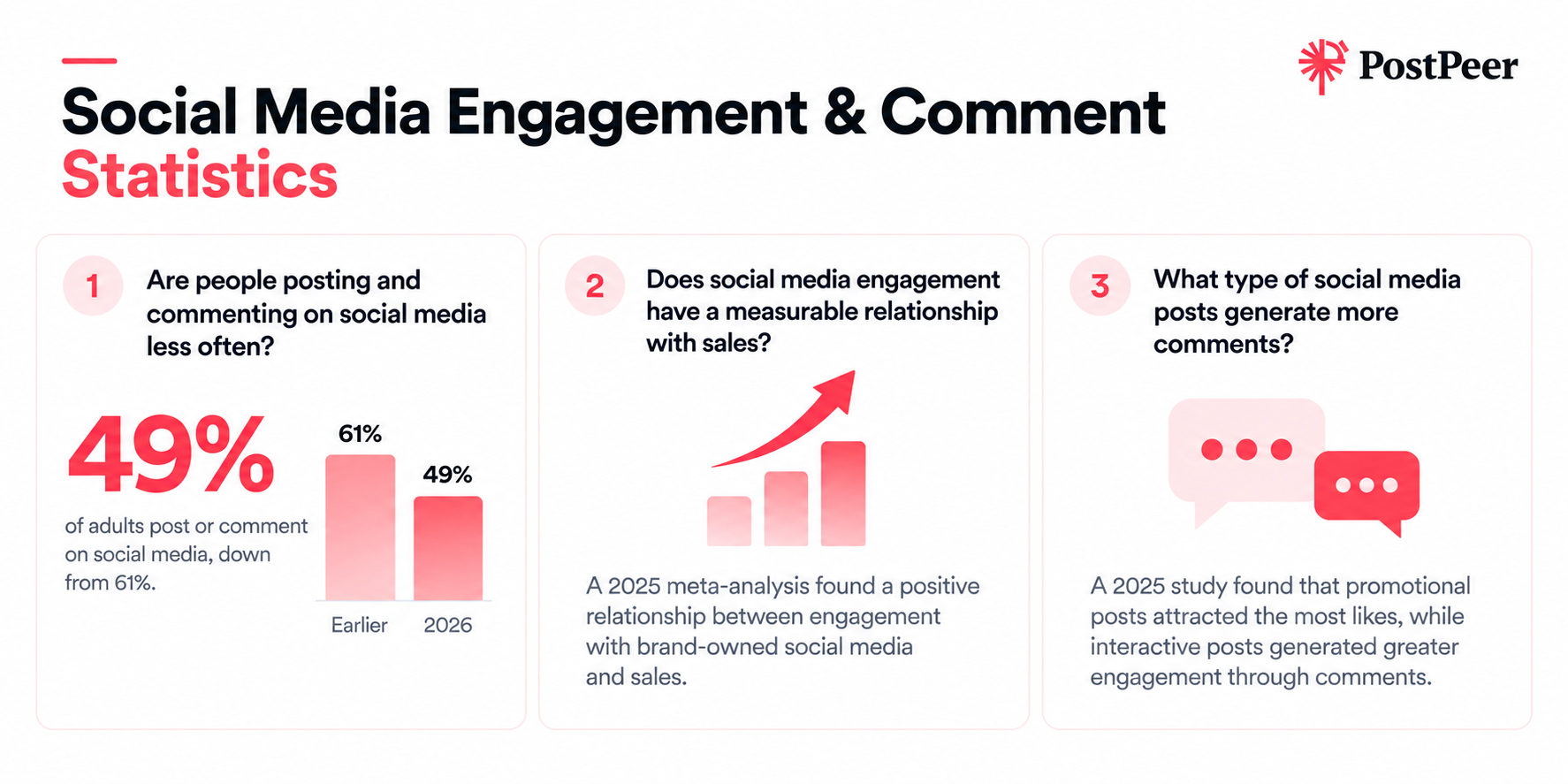
Ofcom's 2026 research found that the proportion of adults posting and commenting on social media fell from 61% to 49%.
Source: Ofcom, Adults' Media Use and Attitudes 2026
Does Social Media Engagement Have a Measurable Relationship With Sales?
A 2025 meta-analysis examined 1,240 effect sizes from 40 publications, covering a combined sample of 1,880,154 observations.
The researchers found a positive relationship between engagement with brand-owned social media and sales. Engagement included likes, comments, shares, and favorites.
Source: International Journal of Consumer Studies, The More They Engage, the More They Consume
What Type of Social Media Posts Generate More Comments?
A 2025 study of Facebook posts from large Polish travel agencies found that promotional posts attracted the most likes, while interactive posts generated greater engagement through comments.
Source: Dariusz Strzębicki, Consumer Engagement on Facebook: The Role of Comments in Travel Agency Brand Interactions in Poland
Social Media Messaging & Customer Care Statistics
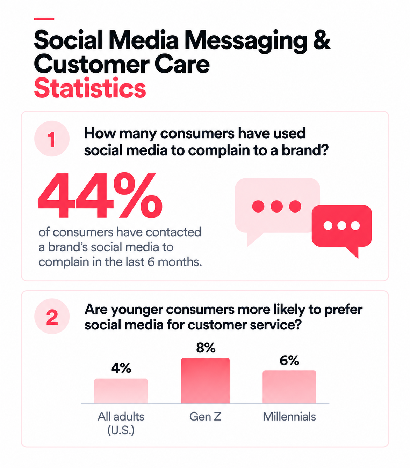
How Many Consumers Have Used Social Media to Complain to a Brand?
YouGov research across 18 international markets found that 44% of consumers had contacted a brand's social-media handle to register a complaint in at least one product category during the previous six months.
Source: YouGov, Exploring the Role of a Brand's Social Media Platforms in Consumer Complaints
Are Younger Consumers More Likely to Prefer Social Media for Customer Service?
In the U.S., 4% of adults prefer social media for customer-service contact, rising to 8% among Gen Z and 6% among Millennials.
Source: YouGov, How Americans Prefer to Contact Businesses for Customer Service
Social Media Analytics & Measurement Statistics
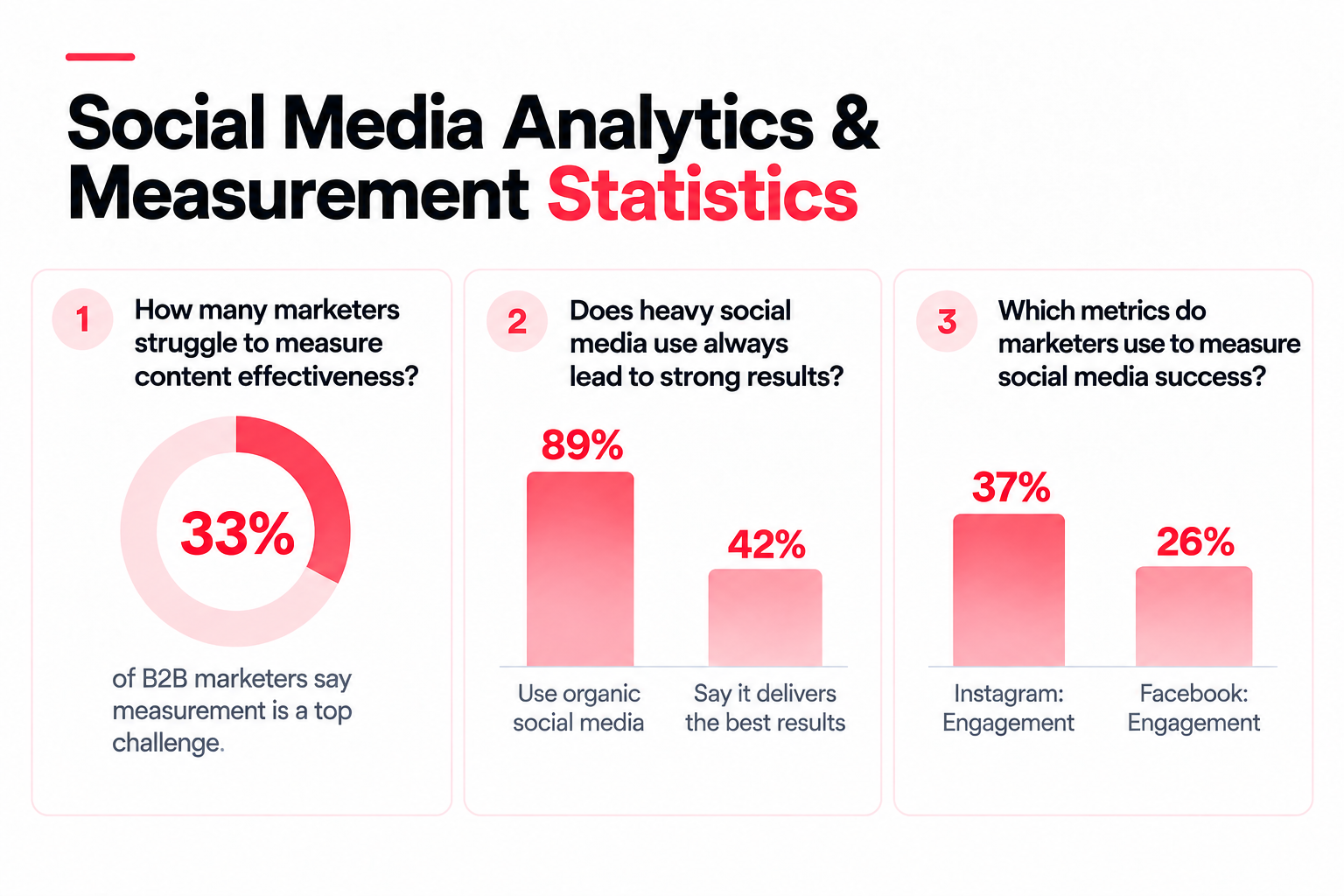
How Many Marketers Struggle to Measure Content Effectiveness?
Content Marketing Institute's 2026 research found that 33% of B2B marketers name measuring content effectiveness as one of their top three content-marketing challenges.
Source: Content Marketing Institute, B2B Content and Marketing Trends: Insights for 2026
Does Heavy Social Media Usage Always Translate Into Strong Results?
Content Marketing Institute found that 89% of B2B marketers use organic social media, while only 42% say organic social is among the distribution channels producing their best results.
Source: Content Marketing Institute, B2B Content Marketing Benchmarks, Budgets, and Trends: Outlook for 2025
Which Metrics Are Marketers Using to Measure Social Media Success?
Digiday's 2025 research found that 37% of marketers named engagement as their main Instagram success metric, while 26% said engagement was their top Facebook metric.
Source: Digiday+ Research, How Marketers Are Spending and Measuring Across Social Media in 2025
AI, Agentic AI, API & Social Media Management Statistics
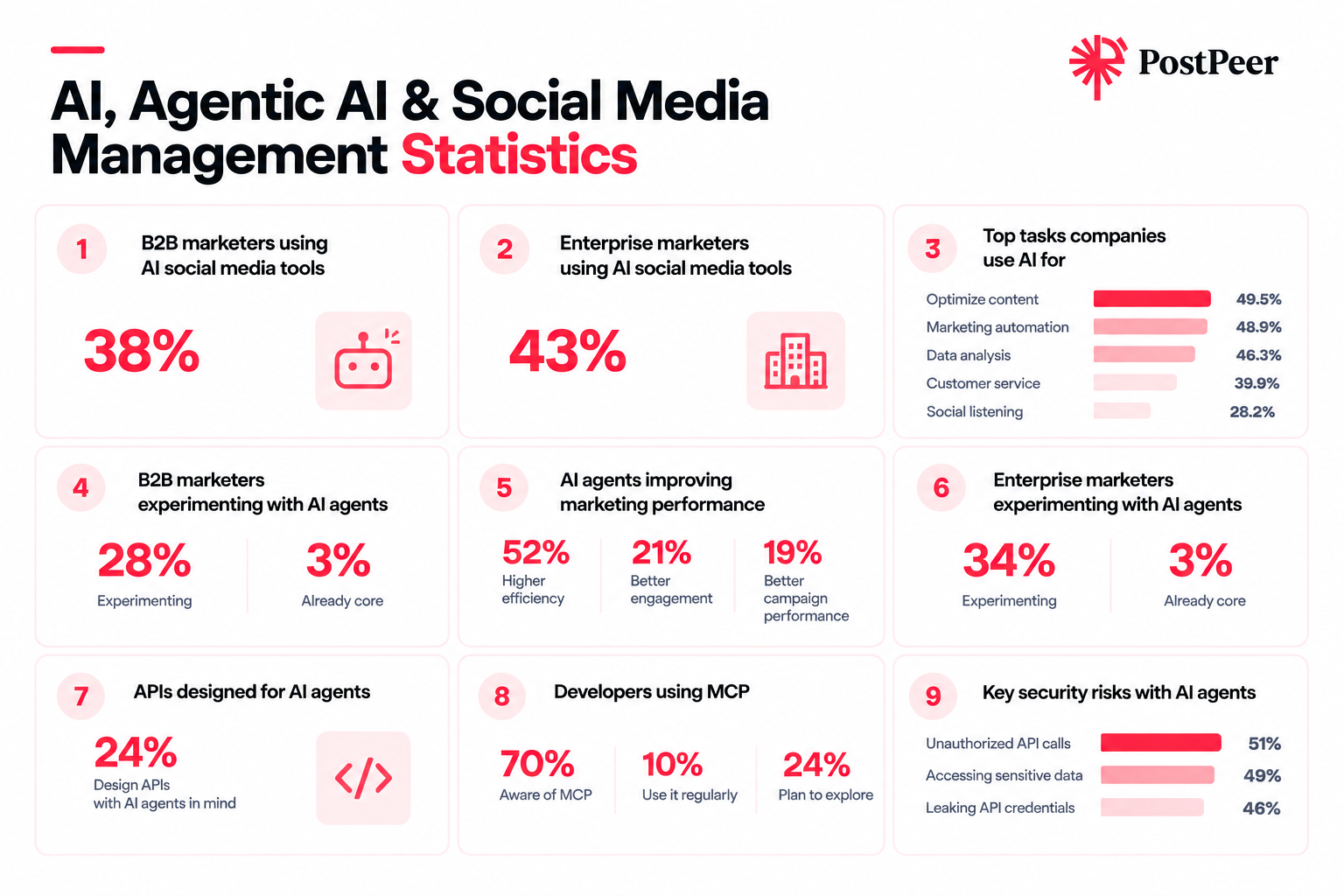
How Many B2B Marketers Use AI-Powered Social Media Tools?
Content Marketing Institute found that 38% of B2B marketers use or are actively implementing AI-powered social media tools for content scheduling, analysis, and automated posting.
This is one of the cleanest AI statistics for this section because it directly covers three social media management workflows: scheduling, analytics, and publishing.
Source: Content Marketing Institute, B2B Content and Marketing Trends: Insights for 2026
How Many Enterprise Marketers Use AI-Powered Social Media Tools?
AI adoption for social media management is slightly higher among enterprise teams.
Content Marketing Institute found that 43% of enterprise marketers use or are actively implementing AI-powered social media tools for content scheduling, analysis, and automated posting.
Source: Content Marketing Institute, Enterprise Content and Marketing Trends: Insights for 2026
Which Social Media Management Tasks Are Companies Using AI For?
The CMO Survey shows AI moving into several activities that directly overlap with social media management. Among companies already using AI in marketing:
- 49.5% use AI to optimize content and timing.
- 48.9% use AI for marketing automation.
- 46.3% use it for data analysis and reporting.
- 39.9% use conversational AI for customer service.
- 28.2% use AI for listening and sentiment analysis.
These are marketing-wide figures rather than social-media-only figures, but each activity maps directly to scheduling, analytics, messaging, customer care, or social listening.
Source: The CMO Survey, Topline Report 2026, page 12
How Many B2B Marketers Are Experimenting With AI Agents?
AI agents are still earlier in adoption than AI-powered social media tools.
Content Marketing Institute found that 28% of B2B marketers are experimenting with AI agents, while just 3% say agents are already a core part of their marketing strategy.
Among more advanced marketing teams, 43% of pacesetters are experimenting with AI agents, and 6% say agents are core to their strategy.
Source: Content Marketing Institute, B2B Content and Marketing Trends: Insights for 2026
Are AI Agents Improving Customer Engagement and Marketing Performance?
Among B2B marketers already experimenting with AI agents, 52% report improved operational efficiency.
More relevant to social media management, 21% report better customer engagement, while 19% report improved campaign performance and ROI.
This matters because an agent connected to social APIs could handle activities such as publishing, retrieving analytics, monitoring comments, or assisting with customer interactions.
Source: Content Marketing Institute, B2B Content and Marketing Trends: Insights for 2026
How Many Enterprise Marketers Are Experimenting With AI Agents?
Among enterprise marketers, 34% are experimenting with AI agents, while only 3% say agents are already a core part of their marketing strategy.
That means most enterprise marketing teams are still testing agentic workflows rather than relying on them as standard infrastructure.
Source: Content Marketing Institute, Enterprise Content and Marketing Trends: Insights for 2026
Are APIs Being Designed for AI Agents?
Postman found that 89% of developers use generative AI in their daily work, but only 24% actively design APIs with AI agents in mind.
Among developers surveyed:
- 13% design APIs equally for humans and AI agents.
- 7% primarily design for AI agents or machine consumption.
- 5% are transitioning from human-first to AI-first API design.
- 60% still design APIs primarily for humans.
- 16% have not considered AI agents as API consumers.
For a social media API, this matters because an AI agent needs predictable endpoints and machine-readable documentation to reliably publish posts, retrieve analytics, or manage interactions. It's exactly why PostPeer ships agent skills and an MCP server alongside the REST API.
Source: Postman, 2025 State of the API Report
How Many Developers Are Using MCP to Connect AI Agents With APIs?
MCP awareness is high, but regular usage is still in the early stages.
Postman found that 70% of developers are aware of Model Context Protocol, while only 10% use MCP regularly. Another 24% plan to explore it.
This matters for social media management APIs because MCP gives AI agents a standardized way to discover and invoke tools, rather than requiring a custom integration for every action.
Source: Postman, 2025 State of the API Report
What Security Risks Matter When AI Agents Manage Social Media Through APIs?
Giving an agent access to publishing, comments, messages, or account data introduces a new security layer.
Postman found that 51% of developers worry about unauthorized or excessive API calls from AI agents. Another 49% are concerned about AI systems accessing sensitive data they should not see, while 46% worry about AI systems sharing or leaking API credentials.
For social media management, those risks could include an agent publishing too often, accessing the wrong account data, or taking actions beyond its permissions.
Source: Postman, 2025 State of the API Report
What These Social Media Management Statistics Mean for 2026
The numbers point to a clear shift: social media teams are no longer just publishing posts. They are coordinating multiple networks, measuring performance, handling conversations, and increasingly connecting those workflows with AI and automation.
PostPeer is built for that environment. Its unified social media API lets developers and SaaS teams handle publishing, scheduling, analytics, comments, and messaging across major platforms through a single integration. You can explore the available endpoints and implementation details in the PostPeer documentation.
This also makes PostPeer useful for products building automated or AI-driven social workflows without maintaining separate integrations for every network.
Sign up to get started with 20 free credits, enough for up to 20 standard API calls on supported endpoints. Visit the PostPeer pricing page to sign up and test the API.
Sources & References
All statistics in this article are based on the original reports, surveys, platform data, and research listed below. Click any source to review the original data.
- The Business Research Company - Social Media Management Market Report 2026
- Grand View Research - Social Media Management Market Size Report, 2026–2033
- Fortune Business Insights - Social Media Management Market Size, Share & Industry Analysis
- The CMO Survey - Topline Report 2026
- The CMO Survey - Firm and Industry Breakout Report 2026
- DataReportal - Digital 2026: 2 in 3 People on Earth Now Use Social Media
- Pew Research Center - Americans' Social Media Use
- Ofcom - Adults' Media Use and Attitudes 2025
- Ofcom - Adults' Media Use and Attitudes 2026
- Content Marketing Institute - B2B Content Marketing Benchmarks, Budgets, and Trends: Outlook for 2025
- Content Marketing Institute - B2B Content and Marketing Trends: Insights for 2026
- Content Marketing Institute - Enterprise Content and Marketing Trends: Insights for 2026
- LinkedIn - LinkedIn Pages Best Practices
- International Journal of Consumer Studies - The More They Engage, the More They Consume
- Dariusz Strzębicki - Consumer Engagement on Facebook: The Role of Comments in Travel Agency Brand Interactions in Poland
- YouGov - Exploring the Role of a Brand's Social Media Platforms in Consumer Complaints
- YouGov - How Americans Prefer to Contact Businesses for Customer Service
- Digiday+ Research - How Marketers Are Spending and Measuring Across Social Media in 2025
- Postman - 2025 State of the API Report